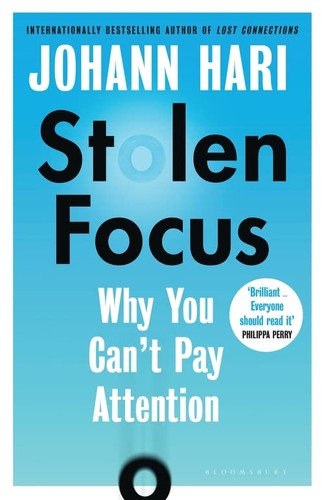
In the United States, teenagers can focus on one task for only sixty-five seconds at a time, and office workers average only three minutes. Like so many of us, Johann Hari was finding that constantly switching from device to device and tab to tab was a diminishing and depressing way to live. He tried all sorts of self-help solutions—even abandoning his phone for three months—but nothing seemed to work. So Hari went on an epic journey across the world to interview the leading experts on human attention—and he discovered that everything we think we know about this crisis is wrong.
We think our inability to focus is a personal failure to exert enough willpower over our devices. The truth is even more disturbing: our focus has been stolen by powerful external forces that have left us uniquely vulnerable to corporations determined to raid our attention for profit. Hari found that …
In the United States, teenagers can focus on one task for only sixty-five seconds at a time, and office workers average only three minutes. Like so many of us, Johann Hari was finding that constantly switching from device to device and tab to tab was a diminishing and depressing way to live. He tried all sorts of self-help solutions—even abandoning his phone for three months—but nothing seemed to work. So Hari went on an epic journey across the world to interview the leading experts on human attention—and he discovered that everything we think we know about this crisis is wrong.
We think our inability to focus is a personal failure to exert enough willpower over our devices. The truth is even more disturbing: our focus has been stolen by powerful external forces that have left us uniquely vulnerable to corporations determined to raid our attention for profit. Hari found that there are twelve deep causes of this crisis, from the decline of mind-wandering to rising pollution, all of which have robbed some of our attention. In Stolen Focus, he introduces readers to Silicon Valley dissidents who learned to hack human attention, and veterinarians who diagnose dogs with ADHD. He explores a favela in Rio de Janeiro where everyone lost their attention in a particularly surreal way, and an office in New Zealand that discovered a remarkable technique to restore workers’ productivity.
Crucially, Hari learned how we can reclaim our focus—as individuals, and as a society—if we are determined to fight for it. Stolen Focus will transform the debate about attention and finally show us how to get it back.
I did not find the book's individual facts and arguments unique or novel, but the connections that Hari makes between them add up to a compelling argument and rise to collective action in a surprising and effective way. Attention and the climate are connected crises, he says convincingly. And Facebook, in the extent of Hari's telling, is so much worse than I thought possible.
I was expecting Stolen Focus to predominantly focus on digital focus, and the negative impacts big tech companies have on our attention. That’s definitely a good portion of this book, which was incredibly insightful, but there are many more concepts tied to focus I had never considered which were equally amazing to learn about.
Diet, environment, social factors, economy, politics, and more. Stolen Focus ties relations between the focus crisis to the climate crisis, the obesity crisis, the mental health crisis, and much more. These are all interlinked problems which feed on each other in disastrous ways.
This book is not a “how to reclaim your focus” guide, it’s rather a thorough investigation into how and why focus is so important, and what has happened to it. It gives you the context and understanding required to not just fight back personally, but socially.
Writing-wise, I was thoroughly impressed with the …
I was expecting Stolen Focus to predominantly focus on digital focus, and the negative impacts big tech companies have on our attention. That’s definitely a good portion of this book, which was incredibly insightful, but there are many more concepts tied to focus I had never considered which were equally amazing to learn about.
Diet, environment, social factors, economy, politics, and more. Stolen Focus ties relations between the focus crisis to the climate crisis, the obesity crisis, the mental health crisis, and much more. These are all interlinked problems which feed on each other in disastrous ways.
This book is not a “how to reclaim your focus” guide, it’s rather a thorough investigation into how and why focus is so important, and what has happened to it. It gives you the context and understanding required to not just fight back personally, but socially.
Writing-wise, I was thoroughly impressed with the structure of the book. I was consistently captured by the book (ironically) as the author had a great balance of personal anecdotes, storytelling, interviews with dozens of experts, scientific research, and more. I felt the balance of facts, evidence, and story were perfect.
Great read, a must read if we are to reclaim some sanity in this insane world.
Audiobook. Covers much that I already knew from “the social dilemma” (documentary) and “down the rabbit hole” (NYT podcast). Powerful first half. I felt unsure about the second half and reading some reviews here from folk with ADHD I wonder if he simplified too much there. Enjoyed his voice and pacing, agree with many of his points. Leaves us with very much of a “what do we do now”? problem though.