1484 pages
English language
Published 2014 by HarperCollins Publishers Limited.
Chimamanda Ngozi Adichie Three-Book Collection
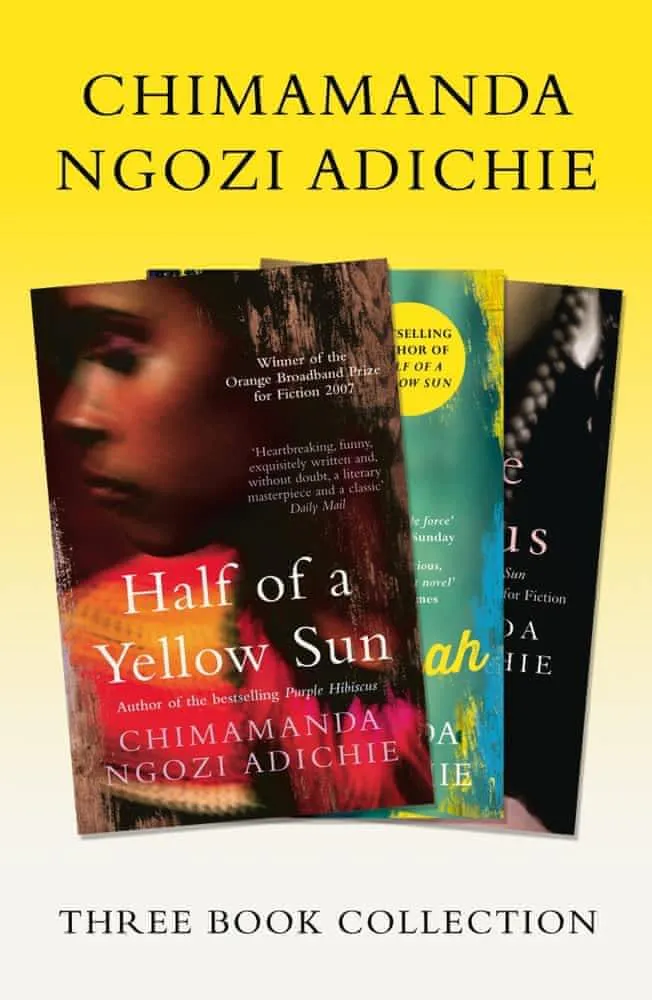
1484 pages
English language
Published 2014 by HarperCollins Publishers Limited.
Half of a Yellow Sun is a 2006 novel by Nigerian author Chimamanda Ngozi Adichie. It won the 2007 Women's Prize for Fiction. The story, which is set in Nigeria in the 1960s, centers on Ugwu, a houseboy of Odenigbo. Odenigbo is a professor and politics enthusiast who is in love with Olanna, the daughter of a wealthy Nigerian man. The characters are, however, thrown into anarchy when the war breaks out. Despite dealing with the serious issues of colonialism and racial inequality, Half of Yellow Sun is renowned for its depiction of the Nigerian Civil War (1967–1970). As a Bildungsroman, the primary themes are loyalty, betrayal, and war. Scholars note that Adichie narrates a love story that includes people from different regions and social classes of Nigeria, and how the war and encounters with refugees affected and changed them. Despite its themes, the novel was banned in 2022 in …
Half of a Yellow Sun is a 2006 novel by Nigerian author Chimamanda Ngozi Adichie. It won the 2007 Women's Prize for Fiction. The story, which is set in Nigeria in the 1960s, centers on Ugwu, a houseboy of Odenigbo. Odenigbo is a professor and politics enthusiast who is in love with Olanna, the daughter of a wealthy Nigerian man. The characters are, however, thrown into anarchy when the war breaks out. Despite dealing with the serious issues of colonialism and racial inequality, Half of Yellow Sun is renowned for its depiction of the Nigerian Civil War (1967–1970). As a Bildungsroman, the primary themes are loyalty, betrayal, and war. Scholars note that Adichie narrates a love story that includes people from different regions and social classes of Nigeria, and how the war and encounters with refugees affected and changed them. Despite its themes, the novel was banned in 2022 in the American school districts of Michigan, Florida, South Carolina, and Utah, citing its sexual and violent imagery. Reactions to the novel varied widely upon publication. Despite the number of copies sold and its widespread use in education, literary analysis generally praised the novel's depictions of the Biafran War and the relationships between the characters but disagreed on the effectiveness of the narrative's pace. It was adapted into a film of the same name in 2013 by Biyi Bandele, and produced by Gail Egan and British film and television producer Andrea Calderwood.