Remarkable First-Contact
5 stars
(em português: sol2070.in/2025/11/livro-hole-in-the-sky/ )
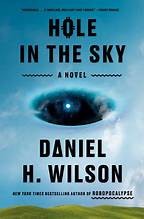
During these blackout days, I read Hole in The Sky (2025, 288 pages), by Daniel H. Wilson, in just a few sittings.
It’s a first-contact story that reimagines the rich Indigenous mythologies and cosmologies tied to the Spiro Mounds archaeological site in Oklahoma. A top-tier page-turner.
A few years in the future, fifty years after the launch of Voyager 1 (which carried messages designed by Carl Sagan for hypothetical aliens), the probe dives into space beyond the influence of the solar system. Data returning from it shows signs of encoded messages. At the same time, sightings of anomalous phenomena spike, especially around that region of Oklahoma, and a secret quantum supercomputer that environmentally channels random prophetic messages suddenly begins speaking in a seemingly conscious manner.
As a member of the Cherokee Nation, Wilson gives a central role to that culture and to older traditions and beliefs …
(em português: sol2070.in/2025/11/livro-hole-in-the-sky/ )
During these blackout days, I read Hole in The Sky (2025, 288 pages), by Daniel H. Wilson, in just a few sittings.
It’s a first-contact story that reimagines the rich Indigenous mythologies and cosmologies tied to the Spiro Mounds archaeological site in Oklahoma. A top-tier page-turner.
A few years in the future, fifty years after the launch of Voyager 1 (which carried messages designed by Carl Sagan for hypothetical aliens), the probe dives into space beyond the influence of the solar system. Data returning from it shows signs of encoded messages. At the same time, sightings of anomalous phenomena spike, especially around that region of Oklahoma, and a secret quantum supercomputer that environmentally channels random prophetic messages suddenly begins speaking in a seemingly conscious manner.
As a member of the Cherokee Nation, Wilson gives a central role to that culture and to older traditions and beliefs shared across other Native American peoples. They even become the raw material for an eerie, Lovecraftian myth of cosmic horror, where dreams and a more mental nature of reality define the shape of things.
The narrative alternates between the first-person points of view of the three protagonists: a Native American man trying to reconnect with his teenage daughter amid family trauma, an autistic NASA analyst, and a government investigator of UAPs (Unidentified Anomalous Phenomena). There’s also the one person capable of interpreting the quantum computer’s messages.
It’s one of those reads that’s hard to put down.
Around the midpoint, when the nature of the contact seems to be getting clearer, I felt disappointed by what looked like a clichéd alien invasion. False alarm, thankfully. Sticking with it was worth it — it’s much more than that.